The quickest way to know whether you are ready to bring AI into your organisation is to ask one question: how confident are we that our controls will actually work? A risk register tells you what could go wrong. It rarely tells you whether the safeguards you are relying on are in place, operating and backed by evidence.
That gap matters more with AI than with most technologies. Generative AI tools can be switched on in days, but the controls around them; training, oversight, data protection, ethics review, audit — take months to mature. Many organisations end up with policies on paper and very little assurance in practice.
This article sets out a practical method for closing that gap. It adapts the bowtie, a well-established risk technique, into a self-assurance tool that scores your confidence in each AI control and adds them up into a single, defensible judgement.
A bowtie diagram puts a risk event in the centre — the "knot" — with causes fanning out on the left and consequences on the right. Controls sit between them: some stop the event happening, others limit the damage if it does.
The twist is to frame the knot positively, as the outcome you want (for example, "successful delivery of AI risk management"), and then give every key control a weighting. The weightings add up to 100%. You then score how much of that weighting each control is genuinely delivering today. The total is your confidence level, and it can be mapped straight onto the assurance language your auditors and board already use.
| Assurance rating |
What it means in plain terms |
| Substantial |
Controls are well designed and working; risks are being managed |
| Reasonable |
Some weaknesses, but risks are broadly under control |
| Limited |
Significant or numerous weaknesses; objectives are at risk |
| No assurance |
Controls are inadequate; failure is likely |
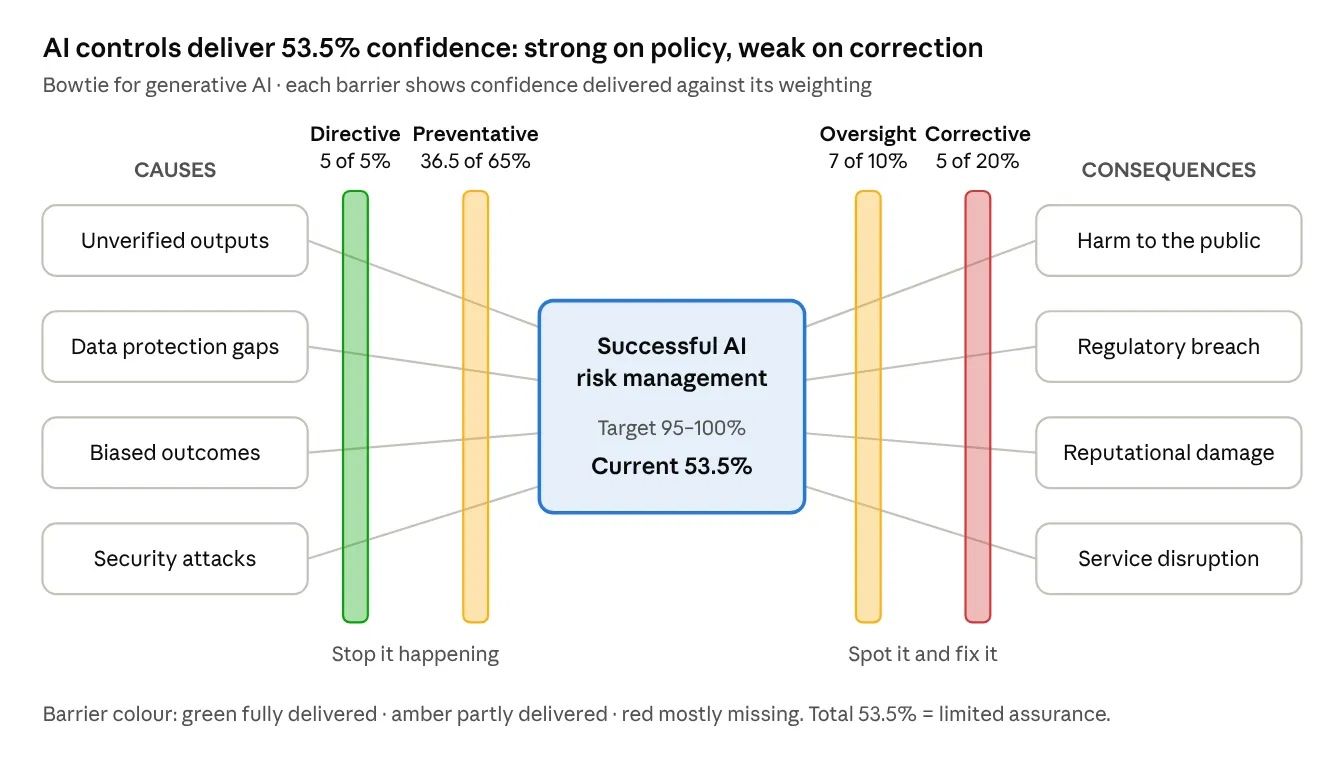
Read left to right: causes run through preventative and directive barriers towards the outcome; oversight and corrective barriers stand between any failure and its consequences.
1. Define the risk domain. Decide what you are assessing: one AI tool, a portfolio of use cases, or AI adoption across the whole organisation. Draw on public standards, playbooks and regulator guidance to build your list of relevant controls.
2. State the outcome and the confidence you need. Write the knot as a positive goal and agree the level of confidence that matches your risk appetite. A cautious organisation might require 95–100% before calling AI risk "managed".
3. Identify the key controls, not every control. Sort them into four groups: preventative, detective (oversight), corrective and directive. Note each control's type — managerial, human, automated, technical, in-house or outsourced — so you can see where you depend on people versus systems or suppliers.
4. Weight each control. Allocate the 100% across your controls according to how much assurance each should provide. This forces an honest conversation about which safeguards really matter.
5. Self-assess actual confidence. Score what each control is delivering now. If it doesn't exist yet, or you can't evidence it, the score reflects that.
6. Add it up. The total is a point-in-time confidence level. Map it to your assurance scale.
7. Act on the gaps. Feed the findings into your risk register, recalibrate likelihood and impact scores, and agree improvement actions.
8. Repeat it. Make the bowtie part of regular risk reviews so you can track confidence rising (or falling) as your AI use grows.
A typical weighting for generative AI might look like this:
| Control Group |
Weighting |
Example |
| Preventative |
65% |
Approved use cases, AI literacy training, human verification of outputs, DPIAs, cyber and ethics assessments, testing, vendor due diligence |
| Corrective |
20% |
Lifecycle performance reporting, human review of automated responses, change management, audits, business continuity, appeal and redress routes |
| Detective / oversight |
10% |
Data and AI ethics board, security committee, technical design authority, AI inventory or public register, named senior accountability |
| Directive |
5% |
AI policy, acceptable use policy, ethics framework, ICO and NCSC guidance, Equality Act and Online Safety Act obligations |
The heavy weighting on prevention reflects a simple reality: with generative AI, the cheapest problem is the one you stop before an output reaches a customer or a decision.
When this method was piloted on generative AI at a large UK local authority, the result was 53.5% confidence — a "limited assurance" judgement against a target of 95–100%.
| Control group |
Expected |
Actual |
Delivered |
| Directive |
5% |
5% |
100% |
| Detective / oversight |
10% |
7% |
70% |
| Preventative |
65% |
36.5% |
56% |
| Corrective |
20% |
5% |
25% |
| Total |
100% |
53.5% |
|
The pattern will be familiar to many organisations. Policies, frameworks and guidance were fully in place. The weaknesses sat in the controls that make those policies real:
• AI literacy training scored 0 of a possible 5%. Staff cannot follow a policy they haven't been equipped to apply.
• Human oversight of outputs and data protection impact assessments delivered only half their expected value.
• Corrective controls were the weakest area: no lifecycle performance reporting, no change management for data or models, no AI-specific audits and no appeal route for people affected by AI decisions.
• Governance had a visible hole: without a data and AI ethics board, that oversight control contributed nothing.
The lesson is simple. Writing an AI policy is the easy 5%. Assurance comes from training, oversight, testing and the ability to spot and fix problems once a system is live.
The bowtie tells you where to point your indicators. Key Risk Indicators (KRIs) track whether your exposure is growing; Key Control Indicators (KCIs) track whether your safeguards are working.
Each low-scoring control in your bowtie is a candidate for a KCI. Each cause on the left-hand side is a candidate for a KRI.
| Indicator |
AI Example |
| KRI |
Number of AI tools in use, including unapproved "shadow AI" |
| KRI |
Volume of personal or sensitive data processed by AI systems |
| KRI |
AI-related incidents, complaints or near misses per quarter |
| KCI |
% of staff who have completed AI literacy training |
| KCI |
% of live AI use cases with a completed DPIA and ethics assessment |
| KCI |
% of AI outputs sampled for human verification |
The method works because it is simple enough for non-specialists, yet structured enough to stand up in front of internal audit. It can start as a whiteboard sketch in a workshop and later move into a spreadsheet or risk system.
Two cautions. A bowtie can oversimplify a complex risk, and it isn't always easy to classify every control neatly. Treat the score as a prompt for challenge, not a precise measurement.
To run your first assessment, bring together the people who own AI use cases, IT security, data protection and risk. Agree the outcome, list your top 20–30 controls, weight them and score them honestly. Most organisations will find, as in the example above, that the biggest gains come from investing in people: training, clear accountabilities and human oversight.
James McConnell is a BCS-accredited trainer with Duco Digital Training, specialising in information security, AI and IT leadership. He is also a Senior Risk Adviser at the City of Edinburgh Council, where he developed the bowtie approach described here.
This article is adapted from "Case study: Using the bowtie method to strengthen key risk control assurance" by James McConnell, first published in ALARM's From Data to Insight: Key Risk Indicators and Key Control Indicators*. Republished with permission.*